Renewable hydrogen to drive the energy transition
Renewable hydrogen is poised to play a key role in the decarbonisation of the economy and in integrating a greater amount of renewable energy into the system. Its large-scale development will require infrastructure capable of transporting, managing and storing it in a safe and flexible manner.

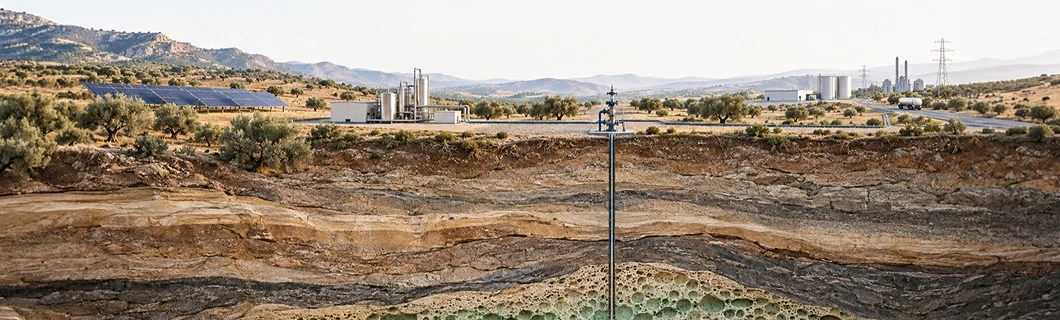
Renewable hydrogen is an energy vector that allows electricity from renewable sources to be converted into a storable and transportable form of energy. Its development opens up new possibilities for harnessing surplus renewable generation and making progress in decarbonising activities where direct electrification is more complex.
Renewable hydrogen can bring new capabilities to the energy system and complement other decarbonisation solutions.
It can make use of surplus generation and reduce the need for production and consumption to match.
It can support the reduction of emissions in certain applications where direct electrification proves to be more complex.
Large-scale renewable energy storage is one of the major challenges of the energy transition. Europe and Spain consider energy storage to be a critical element in guaranteeing system stability and making the most of renewable generation.
The development of large-scale hydrogen storage capacities will make it possible to manage the mismatch between renewable production—variable by nature—and demand, providing seasonal flexibility, security of supply, and price stability.
Furthermore, it will contribute to reducing dependence on fossil fuels and advancing the electrification of hard-to-decarbonise sectors, such as heavy industry and maritime transport.




We are preparing infrastructure for renewable hydrogen
Trinity Energy Storage's operational experience and technical expertise make it possible to address the challenge of large-scale renewable hydrogen storage.
The project on which the company is working represents a technologically viable solution and, more importantly, an efficient transition model, as it leverages existing assets, minimises environmental impacts, and aligns with the European energy strategy.
Aljarafe Project
Scheduled commissioning according to project planning.
Seville
Located approximately 20 kilometres west of the city and close to the Andalusian Hydrogen Valley.
Hydrogen network
Proximity to the planned future backbone network for hydrogen transport.
R+D+i
Development supported by five national and European research initiatives linked to hydrogen storage.
Asset circularity
Utilisation and repurposing of former fields and existing gas infrastructure.
R+D+I for renewable hydrogen storage
Participation in national and European projects allows us to develop knowledge and advance the technical feasibility of underground storage for renewable hydrogen.
Issues such as the geochemical and microbiological interaction of hydrogen, the integrity of the containment system, injection and extraction processes, or the potential impact on the surrounding environment have been the subject of research for years in pioneering projects developed in Spain and Europe
Frequently Asked Questions
What is renewable hydrogen?
Renewable hydrogen is an energy carrier produced from renewable energy. It can store energy, transport it, and facilitate its use at times or in applications other than those of electricity generation.
Why is renewable hydrogen important?
Renewable hydrogen can provide flexibility to the energy system, facilitate the utilisation of surplus renewable energy, and contribute to the decarbonisation of activities where direct electrification is more complex.
What role does renewable hydrogen play in the energy transition?
Renewable hydrogen can complement electrification and help integrate a greater amount of renewable energy into the system. Its development requires infrastructure for production, transport, management and storage.
Why is it necessary to store hydrogen?
Hydrogen storage decouples its production from its consumption over time. This provides flexibility and ensures energy is available whenever demand requires it, even if the renewable energy was generated at a different time.
What is the Aljarafe project?
The Aljarafe Project is Trinity Energy Storage's initiative to develop large-scale underground renewable hydrogen storage by repurposing three depleted gas fields into storage facilities.
How does Trinity Energy Storage contribute to the development of renewable hydrogen?
Trinity Energy Storage contributes through its expertise in underground storage, the development of the Aljarafe Project, and participation in national and European R+D+I projects related to renewable hydrogen storage.
What R+D+I projects related to renewable hydrogen is Trinity Energy Storage developing?
Trinity Energy Storage participates in the following projects: EUH2STARS, PureH2, GUARDIANE-Q, UNDERGY, and UES365. Each addresses different technical, operational, or knowledge-related aspects linked to hydrogen storage.
What benefits does renewable hydrogen offer?
Renewable hydrogen can facilitate energy storage over extended periods, harness surplus renewable generation, and support the decarbonisation of specific sectors and energy uses.
What is the future of renewable hydrogen storage?
Trinity Energy Storage envisions renewable hydrogen storage as a necessary infrastructure for a large-scale hydrogen economy. Its development will depend on technological and regulatory advancements, as well as the evolution of hydrogen networks.
How does renewable hydrogen contribute to decarbonisation?
Renewable hydrogen can replace more emission-intensive energy sources and facilitate the use of renewable energy. Its contribution is particularly significant in applications where direct electrification is more complex.
What is the future of the hydrogen economy?
Trinity Energy Storage operates with a long-term vision in which the development of storage capabilities will be fundamental to the growth of the renewable hydrogen economy. The combination of operational experience, existing assets, technical expertise and R+D+I enables the company to contribute to the development of these essential capabilities for the new energy system.